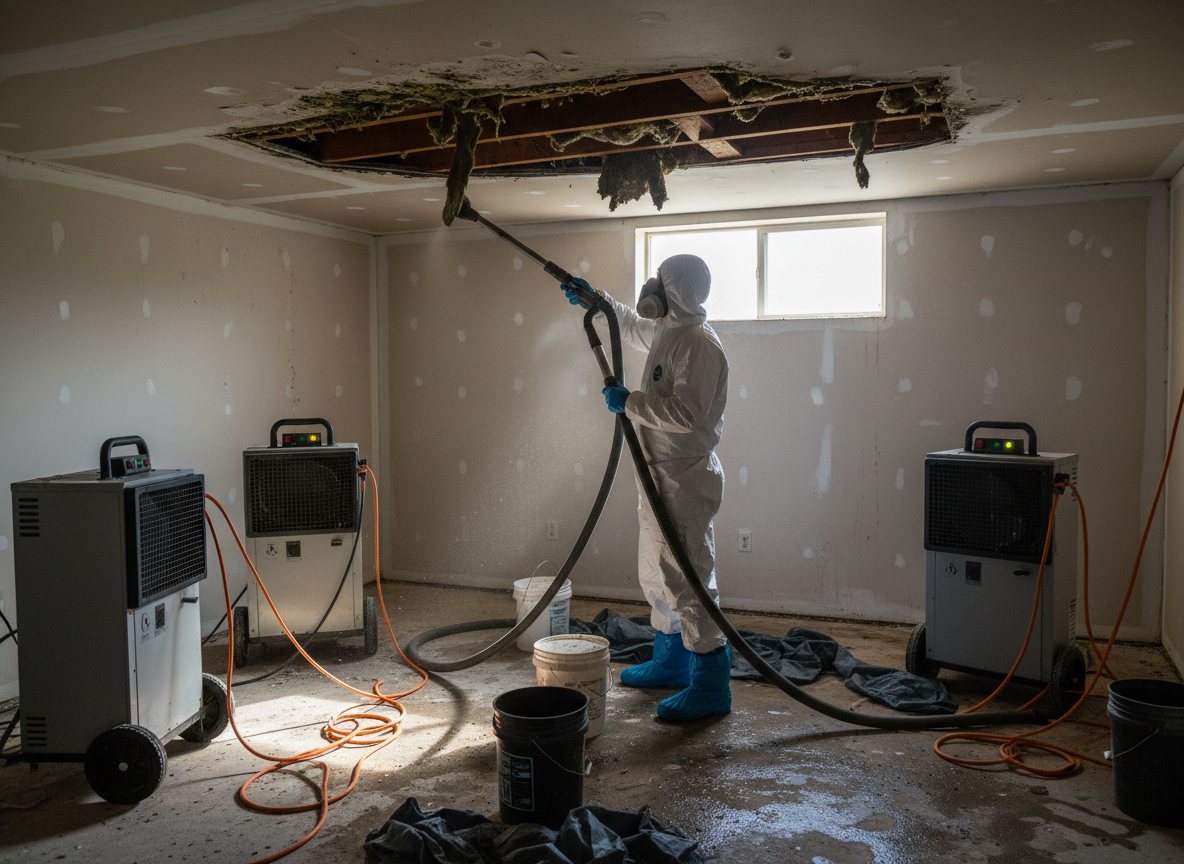
Buckeye’s hot desert climate drives rapid mold growth once water sits in wall cavities or under slab foundations common in Sundance and Westpark homes. After monsoon runoff or appliance leaks, moisture trapped behind stucco or in older fiberglass batts creates hidden colonies within 48 hours. We map moisture with infrared and pin meters, then remove saturated drywall and insulation before spores spread through HVAC returns that many Verrado tract homes share with adjacent units.
Maricopa County building practices often place HVAC ducts in attics where 110-degree summer heat accelerates condensation on cold lines after a roof leak near White Tank Mountain Regional Park. Removing only visible mold leaves cellulose debris that re-wets during the next mild winter rain. Our process includes negative-air containment, HEPA filtration, and antimicrobial application on exposed framing, followed by dehumidification to 35-40 percent relative humidity before new materials are installed.
Nearby Goodyear and Avondale share the same aquifer-driven soil movement that cracks slab foundations, allowing groundwater to migrate under cabinets and vanities. Homeowners in these areas frequently discover black mold on particleboard toe-kicks months after the initial extraction. We cut out affected base plates, treat subfloors with borate solutions, and document moisture readings so insurance adjusters see the full scope without repeated site visits.
Technician insight
In Buckeye, the thing that catches most people out with Mold Damage Remediation After Water Damage is how fast spores colonize the paper facing on insulation behind stucco in Sundance homes once monsoon moisture sits for even two days; the desert heat then pushes humidity into attics where shared ducts in Verrado tract homes spread it to neighboring units before anyone notices.
Westpark Slab Leak Remediation
A homeowner in Westpark discovered musty odors after a slab leak near Buckeye Lake. We found hidden mold under cabinets and in subfloor insulation. Affected materials were removed, surfaces treated, and the space dried to 35 percent humidity. Clearance testing confirmed safe levels for reconstruction.
Mold Damage Remediation After Water Damage Services We Offer
✓Hidden Mold Inspection in Attics and Walls
Infrared scanning and borescope checks locate colonies behind drywall in Verrado and Sundance homes before demolition begins.
✓Containment and Negative Air Setup
Plastic barriers and HEPA air scrubbers isolate work zones to prevent spores from traveling through shared ductwork common in Maricopa County tract homes.
✓Porous Material Removal and Disposal
Saturated drywall, insulation, and carpet pad are cut out and hauled away following local landfill rules for mold-contaminated debris.
✓Antimicrobial Treatment on Framing
EPA-registered solutions applied to exposed wood and concrete after water extraction stops regrowth in humid post-monsoon conditions.
✓Moisture Mapping and Final Drying Verification
Daily meter readings and documentation confirm structural moisture drops below 12 percent before reconstruction starts.
✓HEPA Surface Cleaning and Air Scrubbing
Post-remediation vacuuming and air filtration remove residual spores from hard surfaces in Westpark kitchens and bathrooms.
Mold Damage Remediation After Water Damage Cost in Buckeye, AZ
| Service | Typical Range | What Affects It |
|---|---|---|
| Initial Mold Assessment | $250–$450 | Includes infrared scan and written report; larger homes near Verrado cost more. |
| Containment and Air Scrubbing | $400–$800 | Depends on number of rooms and shared HVAC systems in Sundance. |
| Porous Material Removal | $6–$12 per sq ft | Covers drywall and insulation removal; slab access adds to price. |
| Full Remediation Package | $1,800–$4,500 | Typical for 200–400 sq ft water-damaged area after extraction. |
Ranges are typical for Buckeye, AZ and confirmed with an exact written quote before any work starts.
How it works
- 1
Site Assessment and Moisture Mapping
Technicians inspect affected zones in Buckeye homes using infrared cameras and pin meters to identify all water-damaged materials.
- 2
Containment and Air Filtration
Negative pressure barriers and HEPA scrubbers are installed to isolate the work area from the rest of the property.
- 3
Removal of Contaminated Materials
Saturated drywall, insulation, and baseboards are removed and disposed of following local guidelines.
- 4
Antimicrobial Application and Drying
Treated surfaces are dried with commercial equipment until moisture readings meet industry standards.
- 5
Clearance Testing and Documentation
Final readings and photos are provided so homeowners can proceed with repairs.
Pricing
Pricing varies by square footage, material types, and access difficulty; upfront quotes provided after inspection.