
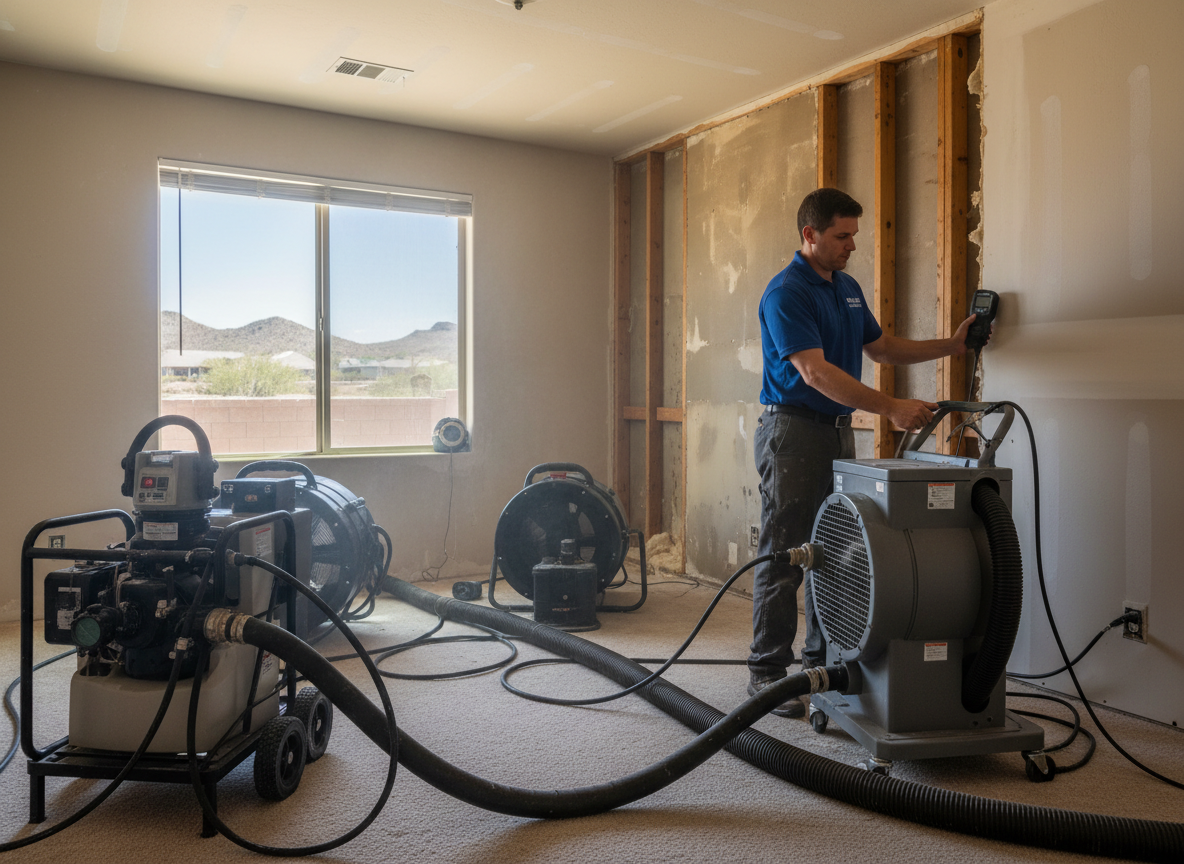
Buckeye sits in Maricopa County where summer heat often exceeds 110 degrees and monsoon rains can overwhelm drainage around Buckeye Lake and White Tank Mountain Regional Park. Homes in Verrado and Sundance frequently feature newer stucco and drywall construction that traps moisture behind walls after leaks or flooding. Industrial dehumidifiers and air movers must run continuously because low humidity outside pulls moisture unevenly, leaving pockets that later cause mold in attics and crawl spaces. Technicians monitor moisture levels with meters at multiple depths because surface readings alone miss saturation in insulation and subfloors common to these neighborhoods.
Westpark properties built on the flat desert terrain often experience water migration along slab edges during heavy rains, especially when combined with irrigation runoff from nearby Avondale and Goodyear developments. Structural drying here requires targeted placement of low-grain refrigerant dehumidifiers to pull moisture from concrete and wood framing without warping. Failure to address these conditions promptly leads to cupping hardwood floors and swelling baseboards that homeowners notice weeks later. Crews document readings daily because Maricopa County building codes require proof of thorough drying before any reconstruction begins.
Mild winters in Buckeye still allow residual moisture to linger inside walls when indoor heating is minimal, creating hidden decay in older sections of Sundance. Proper dehumidification prevents secondary damage that insurance carriers scrutinize closely on claims from this area. Equipment is staged to avoid tripping breakers in homes with older electrical panels found in parts of Verrado Town Center vicinity. The process finishes only when all affected materials reach manufacturer-specified dry standards verified by multiple readings.
Technician insight
In Buckeye the thing that catches most people out with Structural Drying & Dehumidification is how quickly monsoon moisture migrates under stucco in Verrado and Sundance homes because the flat desert lots around White Tank Mountain have poor drainage. Homeowners often stop equipment too soon when surface feels dry, but the real saturation stays in the insulation and slab edges until we hit the proper readings.
Verrado Home After Pipe Leak
A homeowner in Verrado noticed buckling baseboards after a supply line failure. Mapping showed saturation behind drywall extending two feet up on three walls. We set up dehumidifiers and cavity drying tubes for four days until readings stabilized. The structure dried fully without demolition and passed insurance verification.
Structural Drying & Dehumidification Services We Offer
✓Moisture Mapping and Detection
Pinpoint hidden saturation in walls, floors, and ceilings using thermal imaging and meters for Verrado and Sundance homes.
✓Industrial Dehumidifier Placement
Strategic setup of commercial dehumidifiers and air movers sized for desert climate conditions to extract trapped moisture.
✓Slab and Subfloor Drying
Targeted drying under concrete slabs and raised floors common in Westpark properties after monsoon or pipe leaks.
✓Wall Cavity Drying
Injection drying systems to reach insulation and framing cavities without demolition in Buckeye stucco homes.
✓Post-Flood Structural Drying
Full-home drying protocols after flood events near Buckeye Lake to restore structural integrity before repairs.
Structural Drying & Dehumidification Cost in Buckeye, AZ
| Service | Typical Range | What Affects It |
|---|---|---|
| Single room drying | $600–$1,200 | Varies with wall access and runtime needed |
| Whole-home structural drying | $2,000–$4,500 | Larger Verrado homes or multi-room saturation |
| Slab edge drying add-on | $400–$800 | Common in Westpark after heavy rain |
| Daily equipment rental extension | $150–$300 | Per day after initial setup |
Ranges are typical for Buckeye, AZ and confirmed with an exact written quote before any work starts.
How it works
- 1
Initial Assessment
Technicians arrive from 343 Monroe Ave and document moisture levels throughout affected areas using calibrated meters.
- 2
Water Extraction
Standing water is removed first with truck-mounted equipment before drying equipment is positioned.
- 3
Equipment Setup
Dehumidifiers and air movers are placed based on mapping results and run continuously with daily adjustments.
- 4
Monitoring and Verification
Readings are tracked until materials reach dry standards, then equipment is removed and a final report issued.
Pricing
Cost depends on square footage affected, depth of saturation, and number of days equipment must run.